The Yellow-rumped warbler (Dendroica coronata) is one of
the most common winter migrants on both the east and west coast.
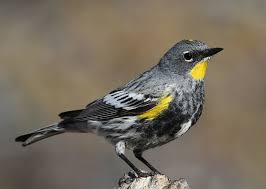
These
warblers prefer coniferous forest, but can also be found in deciduous
forest.
During the winter, these brightly-colored little birds can be
found at back yard feeders.
Yellow-rumped warblers are sexually
dimorphic, meaning that males and females each have distinct
appearances.
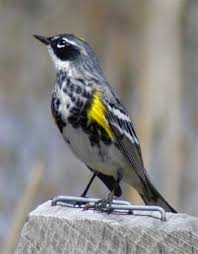
Males are dark gray above with a black breast and
conspicuous yellow highlights on their throat, head, and underneath each
wing.
Females are striped gray with yellow patches on their throat and
underneath each wing.
Both males and females have the yellow patch at
the base of their tail that gives them their name.
 Yellow-rumped
 warblers are unique in that this species was once considered to be two
separate species, the eastern
"Myrtle Warbler" and the western
"
Audubon's Warbler," based on slight differences in appearance and song.
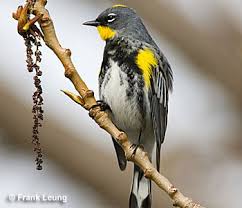
Studies confirmed that the two populations interbreed during summer
when their ranges overlap in western Canada.

The eastern and western
populations are now considered to be subspecies of the
Yellow-rumped
Warbler.
Subspecies are simply populations that are distinct enough that
taxonomists name them separately for convenience.
Subspecies are not
distinct enough, however, that they cannot interbreed.
Yellow-rumped
warblers are mainly insectivorous, and tend to eat insects more often
in the western U.S. than in the eastern part of the country.

During the
winter when insects are not as plentiful, the warblers will eat berries
and visit feeders. This species is the only warbler able to digest the
waxy coating found on bayberries and wax myrtle berries.

Male birds tend
to forage higher up in the canopy than females, and both males and
females can be seen skimming the surface of a body of water to collect
insects. These birds are highly acrobatic, and can snatch insects in
mid-air.
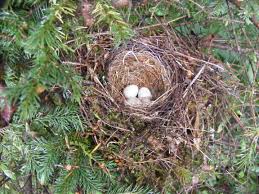 During the breeding season,
 breeding pairs often lay and
raise two broods. Males court females with energetic displays of
feather-puffing and fluttering. The female builds a cup-shaped nest on a
branch out of bark, plants, and roots, and lines the nest with
feathers, sometimes weaving the feathers so that the tips curl over and
hide the eggs.
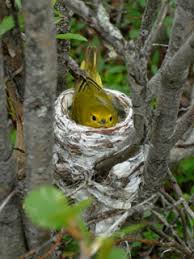
Four to five white eggs are laid for each clutch.
Yellow-rumped
warblers are sometimes target hosts for cowbirds, a
parasitic species that lays its eggs in the nests of other birds.
Uniquely, female Yellow-rumped warblers have the capacity to recognize
cowbird eggs, unlike many species, and will bury the egg deep in the
nest and cover it will nesting material to prevent it from being
incubated.

Incubation lasts from 12 to 13 days, and during the
first days of the chicks' lives, both parents cooperate to provide them
with food.
The chicks fledge after 10 to 12 days. Immature birds are
streaked with soft gray and have the distinctive yellow markings beneath
the wings and at the base of the tail.


